
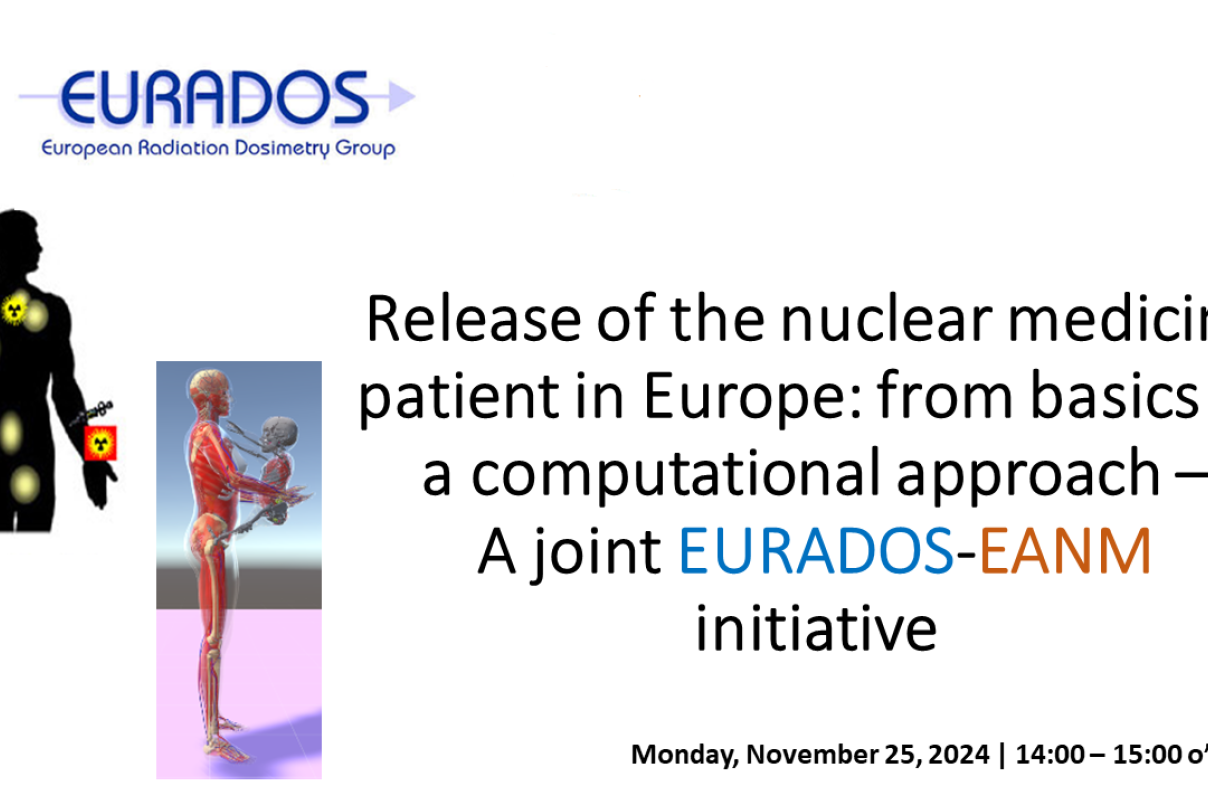
25th EURADOS Webinar: Release of the nuclear medicine patient in Europe: from basics to a computational approach - A Joint EURADOS-EANM initiative
online event
14:00-15:00 CET
Overview
The increasing number of nuclear medicine procedures, along with the development of new radiopharmaceuticals, has raised concerns about radiation risks and the radiological protection of not only patients but also medical staff, caregivers, and the general public who come into contact with patients after diagnostic or therapeutic procedures.
To ensure adequate radiological protection for these groups, it is essential to consider the radiation emitted by patients during their hospital stay and after release. While radiation exposure for medical staff is well documented due to routine individual monitoring programs and numerous optimization studies, the potential exposure of caregivers and the public after release of the patients from the hospital is less thoroughly studied. Moreover, recommendations for releasing nuclear medicine patients following both therapeutic and diagnostic procedures vary widely across the world. For example, in Europe, the discharge criteria for patients treated with iodine-131 differ between countries. In Germany, patients are required to remain in the hospital for 48 hours after treatment or diagnosis before whole-body activity is measured to determine if release is safe. In contrast, in some other European countries, patients can be released after treatment, moreover, the limits of external dose rates for release of patients after I-131 treatment vary across European countries.
To provide scientific information of this variability, in 2017, the European Radiation Dosimetry Group (EURADOS) and the Radiation Protection Committee of the European Association of Nuclear Medicine (EANM) launched a joint project to assess the external dose rates of nuclear medicine patients utilizing biokinetic models, Monte Carlo simulations, and direct measurements to provide scientific data that may guide recommendations on patient release.
In this webinar, experts from EURADOS and EANM will present the project's progress, focusing on three radiopharmaceuticals, [99mTc]Tc-HDP/MDP, [18F]F-FDG and Na[131I]I. The webinar will also introduce future plans for radiopharmaceutical therapies, such as [177Lu]Lu-PSMA and [177Lu]Lu-DOTATATE, and discuss efforts for how to harmonize the release criteria for patients after diagnostic and treatment procedures across Europe.
Programme
- Introduction (Weibo Li)
- Introduction of EANM RP Committee (Jens Kurth)
- Legislative aspects of patient discharge in Europe, results from SimpleRad project (Peter Covens)
- Clinical experience and needs in the radiopharmaceutical therapy (Kristoff Muylle)
- Computational approach to assess external dose rates from NM patients (Lara Struelens)
- Q&A and Discussion for future
Organisation
This webinar is organised by EURADOS Pilot Group "Dosimetry in Nuclear Medicine".
Registration info
The webinar is free of charge.
Registration for the Zoom link:
https://zoom.us/meeting/register/tJIldu6hrzgrHNevc1UhvlgtHHFl1o7eShHb#/registration
Speakers
Weibo Li
Chair EURADOS Pilot Group "Dosimetry in Nuclear Medicine", Federal Office of Radiation Protection, Germany
Dr. Li is a scientific officer at the Federal Office of Radiation Projection (BfS), Germany. He received PhD in Physics from Technical University of Munich (TUM) in 2002. From 1997 to 2022, he worked for Helmholtz Zentrum München (HMGU) (formerly GSF) and there he was leading a work group on “Optimization of Radiation Applications in Medicine”. From 2022, he is leading the EURADOS Pilot Group of "Dosimetry in Nuclear Medicine". Dr. Li is EURADOS liaison of EANM Dosimetry Committee. He is also coordinator of the task “Internal Microdosimetry” in EURADOS Working Group 7. Dr. Li has experiences in simulation of radiation DNA damages, in biokinetic modelling and internal dosimetry and in uncertainty and global sensitivity analysis in radiation medicine dosimetry. He has authored more than one hundred of scientific papers. He is Editorial Board Member of Radiation Medicine and Protection (Online ISSN: 2666-5557).
Jens Kurth
Chair EANM Radiation Protection Committee, Rostock University, Germany
Jens Kurth is chief medical physicist at the Department of Nuclear Medicine at Rostock University Medical Center (Germany). He holds a degree in electrical engineering and a doctorate in engineering from the University of Rostock (Germany). He completed a postgraduate degree in medical physics at the Technical University of Kaiserslautern (Germany) and later habilitated in experimental nuclear medicine at the University of Rostock (Germany). His academic background is in the clinical implementation of dosimetry for novel radionuclide therapies, quantitative imaging in nuclear medicine and radiation protection. Jens is an active member of various national and international organizations and medical associations and of some of their respective committees.
Peter Covens
Department of Molecular Imaging and Therapy, University of Brussel - VUB, Belgium
Peter Covens is a certified radiation protection expert and head of the radiation protection department of the University of Brussels (VUB). Furthermore, he is also research professor at the Molecular Imaging and Therapy research group of VUB where he focusses on preclinical dosimetry and dosimetry aspects in radiobiology. Peter Covens has a background in engineering, nuclear physics, accelerator physics and radiation protection dosimetry with a wide expertise in nuclear measurement techniques and various radiation protection issues related to medical applications. He is a former member of the EANM radiation protection committee and a current member of the EURADOS working group 12- Dosimetry in medical imaging and the Pilot Group “Dosimetry in Nuclear Medicine".
Kristoff Muylle
Nuclear medicine department at the University Hospital of Brussels (UZ Brussel) and Nuclear medicine department at AZ Delta in Roeselare, Belgium
After completion of his medical studies in 1999 and his training in Nuclear Medicine in 2004 at the Free University of Brussels (VUB), Kristoff Muylle started his professional career at the Jules Bordet Cancer Institute in Brussels, where his work mainly focused on clinical and research activities related to nuclear medicine procedures in (hemato-)oncology with a specific interest in radioimmunotherapy and immuno-PET. In 2016, he joined the clinical staff of the nuclear medicine department at the University Hospital of Brussels (UZ Brussel) and combines this activity with a position as nuclear medicine physician at AZ Delta in Roeselare since July 2018, currently serving as head of the department. Kristoff Muylle was Board Member of the Belgian Society of Nuclear Medicine (Belnuc) from 2009 until 2016, serving as President from 4/2014 until 4/2016 and as Belgian EANM-Delegate from 2009 until 2014. He joined the Board of the European Association of Nuclear Medicine (EANM) as President-Elect in 2015 and served as EANM President in 2017 and 2018.
Lara Struelens
Belgian Nuclear research Centre SCK CEN, Institute of Nuclear Medical Applications, Mol, Belgium
Dr. Lara Struelens is head of the research group on dosimetric applications at SCK CEN. She obtained her PhD in 2005 in Applied Sciences from the Free University of Brussels in collaboration with SCK CEN and since then has participated in and coordinated several national and European research projects in the field of radiation dosimetry, specific for medical radiation applications. For more than 20 years she is involved in EURADOS, specifically in WG6 on computational dosimetry and the last years also in the Pilot group on Dosimetry in Nuclear Medicine. She coordinates the task on ‘External dose rates from nuclear medicine patients’ which is a joint action between several working groups within EURADOS (WG6, WG7 and WG12) and the RP committee from EANM. For 4 years she is also member of the scientific committee of EURAMED (the European Alliance for Medical Radiation Protection Research).