
26th EURADOS Webinar: Secondary Radiation in a Compact Proton Therapy System with a Gantry-Mounted Synchrocyclotron - EURADOS Insights and Results
online
14:00 CET
Overview
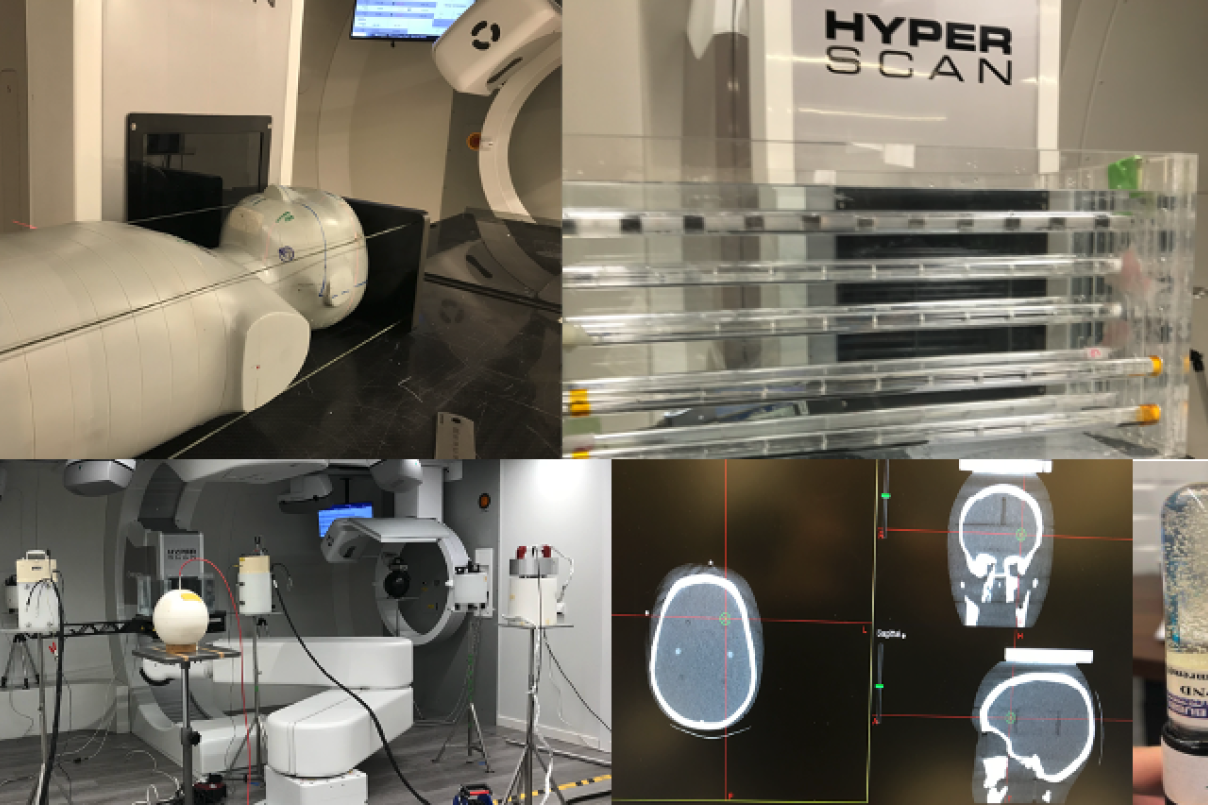
Proton therapy is known for its precise dose delivery, but secondary radiation—especially neutrons—remains a challenge for patient radiation protection. Understanding and accurately measuring these unwanted doses is crucial, particularly for new techniques like the compact proton therapy systems Mevion S250i Hyperscan, where the synchrocyclotron is mounted directly on the rotating gantry. Mevion S250i Hyperscan provides a scanned 227 MeV proton beam, delivered in pulses with a pulse width of 10 μs at 750 Hz frequency, which is afterwards degraded in energy by an energy modulator system.
EURADOS Working Groups WG9 (Radiation dosimetry in radiotherapy) and WG11 (High-Energy Radiation Dosimetry) joined forces to investigate the neutron and gamma radiation fields generated in this unique system.
In the last 10 years WG9 has conducted comprehensive measurements of out-of-field neutron and photon doses inside water phantoms and pediatric anthropomorphic phantoms irradiated with photon and proton systems. By using a well-characterized set of passive detectors and advanced spectrometry systems available among our members, WG9 has produced high-quality dosimetric data that enhance understanding of secondary and scattered radiation fields.
WG11 has extensive experience in high-energy neutron dosimetry in pulsed fields using rem counters, valuable tools for on-line assessment of neutron H*(10). However, selecting an appropriate survey meter requires proper prior knowledge of the facility and radiation field. The Mevion proton beam, delivered in 10 μs pulses at 750 Hz, poses unique challenges for commercial rem counters, due to both its energy and time structure. We tested the reliability of widely used rem counters to evaluate their limits in this stray neutron field.
Programme
- Welcome & Introduction (Liliana Stolarczyk)
- Proton Therapy Facility with a Gantry-Mounted synchrocyclotron (Gloria Vilches-Freixas)
- Assessing Secondary Radiation: Insights from Passive Detector Measurements (Marie Davidkova)
- Active Detectors in Pulsed Proton Fields: Challenges & Findings (Gabriele Zorloni)
- Unfolding the Spectrum - Results of neutron spectrometry (Carles Domingo)
- Q&A
Organisation
This webinar is organised by EURADOS WG9 and WG11 jointly
Registration info
Speakers
Gloria Vilches-Freixas
Medical Physicist. Department of Radiation Oncology (Maastro), GROW School for Oncology and Reproduction, Maastricht University Medical Centre, Maastricht, The Netherlands
Gloria Vilches-Freixas is a medical physicist with a background in photons and in particle therapy. She graduated from the Faculty of Physics at the University of Barcelona in 2007 and obtained her medical physicist diploma from the University Tor Vergata in Rome in 2011. She earned her PhD in dual-energy CT imaging at INSA-Lyon in France in 2017. After working at the Fondazione CNAO in Pavia for three years, she joined Maastro in Maastricht in 2017, a radiotherapy department offering a wide range of treatments including brachytherapy, photon, and proton radiotherapy. Her fields of interest include dosimetry, treatment planning, surface scanning, and imaging. Over the past years, she has initiated a project to assess the feasibility of using proton therapy for treating pregnant patients.
Gabriele Zorloni
ELSE NUCLEAR Srl, Italy
Gabriele Zorloni is a nuclear engineer with expertise in radiation measurement and radiation detector R&D. He graduated in Nuclear Engineering from Politecnico di Milano in 2017 and earned his PhD in Energy and Nuclear Science and Technology in 2021. Following two years as a postdoctoral researcher at the CERN Radiation Protection group, he joined ELSE NUCLEAR as R&D Engineer. Since 2017, Gabriele has been Active Member of EURADOS, participating in the activities of Working Groups 9 and 11, with a focus on high-energy pulsed-field dosimetry.
Marie Davídková
National Radiation Protection Institute, Prague, Czech Republic
Marie Davídková is a nuclear engineer with expertise in dosimetry and radiobiology. She graduated at the Faculty of Nuclear and Physical Engineering of the Czech Technical University in Prague in 1994. She defended her PhD in the field of molecular and cellular biology and biophysics at the Université d’Orléans in France. She worked as a researcher in the Radiation Dosimetry Department of the Nuclear Physics Institute of the Czech Academy of Sciences. Her professional interests are related to radiation protection and biological effects of ionizing radiation. Marie is a Member of EURADOS WG9.
Carles Domingo
Universitat Autònoma de Barcelona (UAB)
He is the head of the Ionising Radiation Research Group at the Physics Department of Universitat Autònoma de Barcelona (UAB). He received Ph.D. in physics in 1988 from UAB. He has 30+ years of experience in radiation measurements, metrology, and Monte Carlo simulations. He co-authored over 120 indexed scientific publications and participated in about 50 funded research projects in the Radiation Physics field. Currently he is involved in projects on neutron radiation detection and spectrometry.