
33rd EURADOS Webinar: Timepix4 spectral measurements to support deep learning for staff dose assessment during interventional procedures
online, 14:00-15:00 CEST
Overview
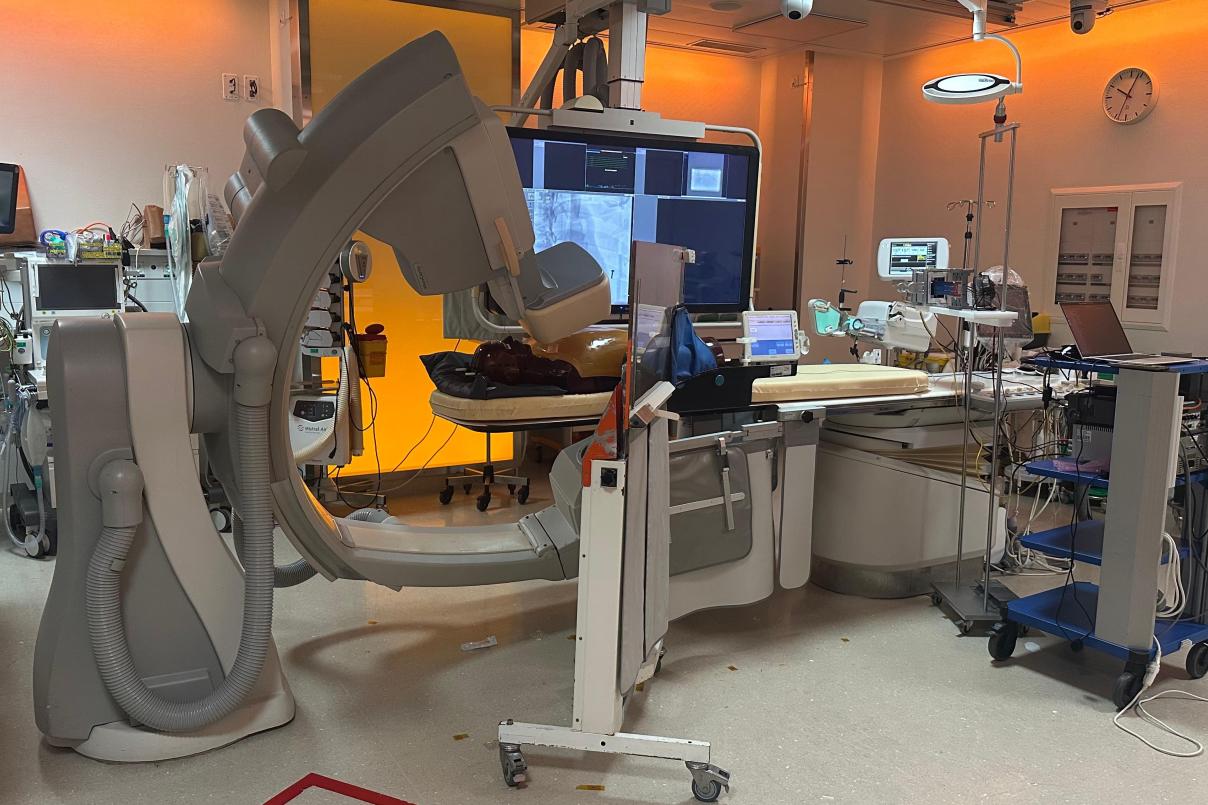
Interventional procedures is a family of minimally invasive, live saving medical procedures (from cardiac surgeries and stent implantation to aneurysm coiling) using X-ray imaging that reduce surgical risk for patients. However, medical personnel are exposed to pulsed, complex low-dose radiation fields that vary significantly during procedures and are highly inhomogeneous. Accurately assessing the cumulative dose received by staff is therefore particularly challenging. This webinar presents a combined approach to tackle this problem, coupling Timepix4-based spectral measurements with deep-learning-driven computational personal dosimetry.
The Timepix4 hybrid pixel detector, developed by the Medipix4 Collaboration, was characterised and calibrated for accurate fluence measurements using X-ray reference beam qualities relevant to interventional radiology. Measurement campaigns were conducted in urology and interventional cardiology theatres, providing accurate energy and time dependent fluence spectra. These datasets are used by EURADOS Working Group 12 to validate Monte Carlo simulations, supporting accurate computational personal dosimetry.
As traditional Monte Carlo methods carry prohibitive computational costs for real-time applications, a learning-based approach was developed to compress large Monte Carlo-simulated radiation field datasets into compact neural networks. These networks predict radiation fields smoothly across the continuous domain parameter space, enabling real-time dose estimation. The full pipeline, from physical modelling through Monte Carlo simulation to neural network prediction, is validated using both spatially resolved ionization chamber measurements and Timepix4 spectral measurements, demonstrating how detector characterisation and machine learning can be combined into a practical dosimetry solution for interventional procedures.
Programme
- Introduction (Eurados, WG12, Early careers initiative and activities within Eurados) 5 min
- Tristan Genetay (CERN / CHUV): The Timepix4 detector as an X-ray spectrometer for dosimetry applications during interventional procedures. 20 min
- Felix Lehner (PTB / TU Braunschweig): Towards Computational Real-Time Dosimetry using Neural Networks. 20 min
- Q&A session
Organisation
This webinar was orgnised by the EURADOS Early Career Scientists.
Speakers
Tristan Genetay (CERN / CHUV)
Tristan is a PhD student at CERN, Lausanne University Hospital, and the University of Lausanne. His research focuses on characterizing scattered radiation fields in hospital theatres using the Timepix4 detector, developed by the Medipix team at CERN. Tristan holds an MSc in medical physics from the University of Nantes, France.
Felix Lehner (PTB / TU Braunschweig)
Felix is a PhD student at PTB and the Technical University of Braunschweig. His research focuses on the development of small neural networks for predicting spatially resolved radiation fields during interventional radiology procedures that are suitable for real-time visualization as well. Felix holds an MSc in computer science with focus on visual computing from the Technical University of Braunschweig.