
34th EURADOS Webinar: Citizen Science Detectors in Action: Applications, Experiences & Lessons Learned
online, 14:00-15:30 CET
Overview
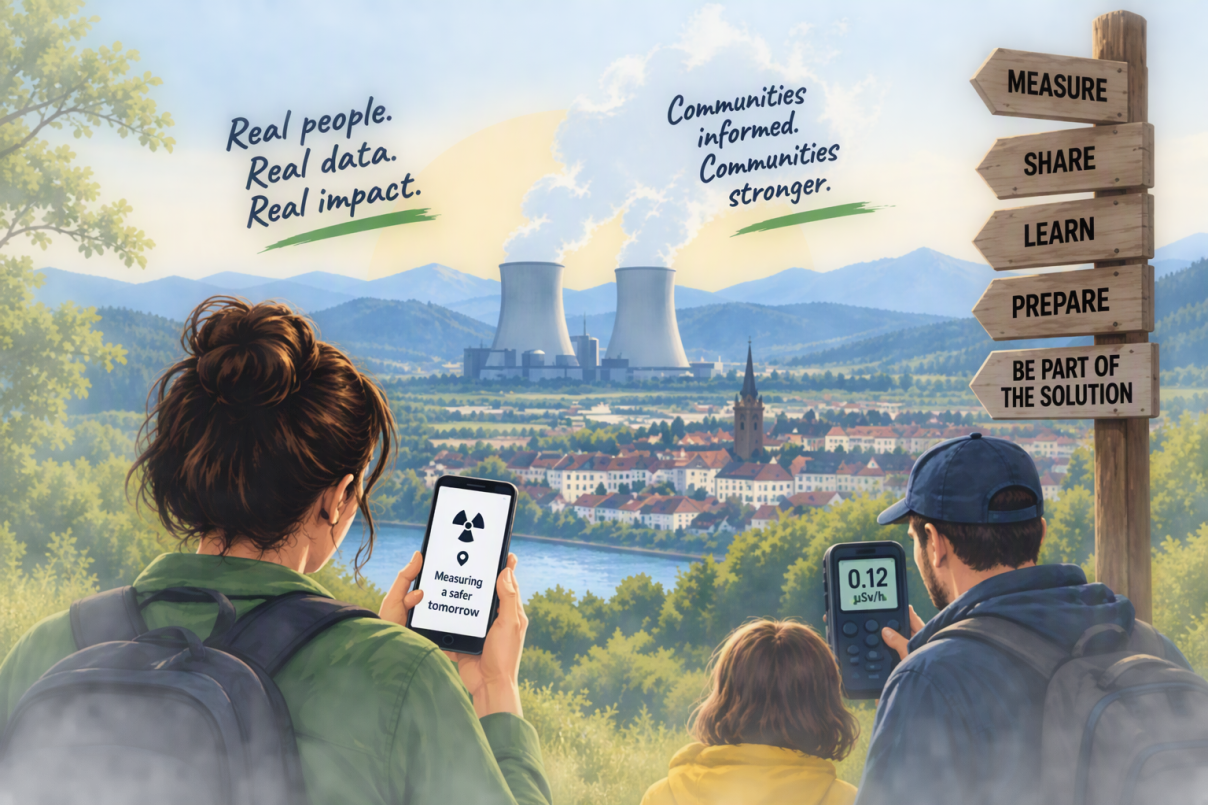
Citizen science gained a lot of focus after the Fukushima accident because it highlighted the importance of enabling members of the public to participate in radiation measurements, environmental monitoring, and the collection and interpretation of scientific data. Through examples of practical applications, the webinar will examine how citizen-led measurements can support environmental radiation monitoring, contribute to emergency preparedness, improve public awareness of radiation risks, and complement professional monitoring networks. It will also address the opportunities and challenges associated with measurement accuracy, data quality, accessibility, and public communication. During the webinar, a range of low-cost and accessible radiation detectors will be discussed. The aim of this webinar is to emphasize how citizen science can strengthen radiation protection, foster transparency, and empower communities to engage actively with radiation crises.
Programme
14:00 – 14:10 Introduction of the webinar topic and speakers
14:10 – 14:30 "Citizen measurements of radioactivity: past, present and future", Jean-Marc Bertho, ASNR, France
14:30 – 14:50 "Raising public awareness by citizen radiation measurements in Czechia", Marie Davídková, SÚRO, Czech Republic
14:50 – 15:10 "Development of a citizen ionizing radiation monitoring network for strengthening radiological emergency preparedness: experience from Poland", Anna Mrozik, IFJ PAN, Poland
15:10 – 15:30 "Citizen radiation science – opportunities and challenges", Christian Bernhardsson, Lund University, Sweden
Registration info
Speakers
Jean-Marc Bertho
Nuclear safety and radiation protection authority, ASNR, France
Jean-Marc Bertho has over 35 years of research experience in radiation biology and radiation toxicology. He is implicated in emergency preparedness, response and recovery since more than 15 years, with special interest in practical radiation protection culture, co-expertise process and citizen science. He is currently the coordinator of OpenRadiation, a citizen network aiming at empowering people about radiation measurements.
Marie Davídková
National Radiation Protection Institute, SURO, Prague, Czech Republic
Marie Davídková is a nuclear engineer with expertise in dosimetry and radiobiology. She worked for many years as a researcher and leader of the radiation biophysics group in the Radiation Dosimetry Department of the Nuclear Physics Institute of the CAS. Her professional interests are related to radiation protection and the biological effects of ionizing radiation. Recently, she has been involved in research projects at the National Radiation Protection Institute focused on public awareness and citizen science.
Anna Mrozik
Institute of Nuclear Physics Polish Academy of Sciences, IFJ PAN, Poland
Anna Mrozik is a researcher at the Institute of Nuclear Physics Polish Academy of Sciences (IFJ PAN). Her scientific expertise focuses on luminescence–based dosimetry with particular interest in retrospective and emergency dosimetry. She is involved in EURADOS activities, contributing to WG10. In recent years, her interests have increasingly extended towards citizen science in radiation protection in Poland. She participates in the CITISTRA project, which explores citizen engagement and public involvement in radiation–related issues, including public measurements of environmental radiation levels.
Christian Bernhardsson
Medical Radiation Physics, Department of Translational Medicine, Lund University, Sweden
Christian Bernhardsson is Associate Professor of Medical Radiation Physics at Lund University, Sweden. His research focuses on environmental radiology, dosimetry, and emergency preparedness. For more than 20 years, a central part of his research has been the development of retrospective and prospective dosimetry methods using optically stimulated luminescence in ordinary salt. More recently, this research has expanded to explored salt as a “folk dosemeter,” leading to the development of a new concept in this field. In connection with citizen radiation science, Bernhardsson is also evaluating emerging radiation detectors for public use and their potential role in radiation emergency preparedness and response.