
EURADOS WG11 - Webinar 1 “Pulsed radiation fields: Methods of production”
AAllll iinnffoorrmmaattiioonn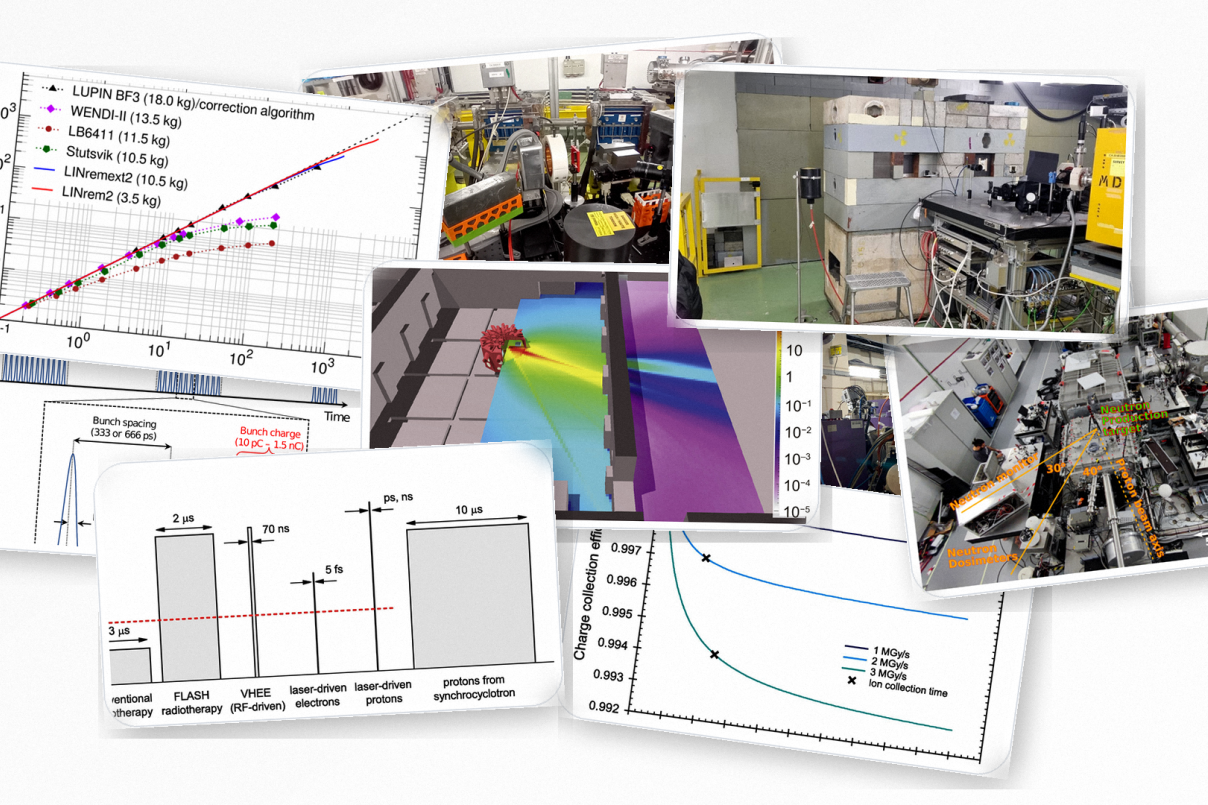
online, 14:00-15:15 CEST
Overview
EURADOS WG11 - Webinars “Pulsed radiation fields: Methods of production and Dose measurements”
Abstract
Recent advances in laser-driven accelerators have boosted the development of high dose-rate, fast-pulsed facilities worldwide. In these environments, stray radiation is dominated by high-energy photons, producing extremely high instantaneous dose rates up to several kGy/s, delivered within pulse durations on the order of femto- to picoseconds. Other facilities generating mixed pulsed radiation fields include particle accelerators with fast-extracted beams, plasma wakefield accelerators, spallation sources, thermonuclear fusion facilities, and accelerators used for FLASH radiation therapy within the medical field.
At such facilities, pulse durations are typically far shorter than the dead time of detector systems (generally a few microseconds for state-of-the-art instrumentation). The combination of very small duty factors and very high instantaneous dose rates imposes severe limitations on radiation protection instrumentation and makes dose measurements particularly challenging. Instruments therefore need to be evaluated for their linearity in response and must ideally be validated under representative conditions. Over recent years, Working Group 11 of EURADOS has promoted a series of intercomparisons aimed at testing instruments and methodologies in pulsed stray radiation fields.
Working Group 11 is organising two webinars on pulsed radiation fields. The first webinar will cover the production mechanisms and characteristic features of pulsed fields and will present example facilities. The second webinar will bring together expert contributions on dose-measurement technologies applicable to pulsed radiation fields.
Topics
Marco Caresana
Title General characteristics of pulsed and mixed radiation fields
Abstract Pulsed and mixed radiation fields represent a major challenge in radiation detection and dosimetry, particularly when high instantaneous dose rates and large dose-per-burst values are involved. The definition of a pulsed radiation field is not univocal: the term “pulse” may refer either to the temporal structure of the radiation field itself or to the electrical signal generated at the detector output. Moreover, the classification of a field as pulsed depends not only on the time structure and production mechanism of the radiation (e.g., accelerator-based sources), but also on the temporal response, dead time, charge collection dynamics, and saturation behavior of the detection system. Under such conditions, conventional assumptions of steady-state fields may no longer be valid, and detector response can be significantly affected by recombination effects, space-charge phenomena, pile-up, and non-linearity at high dose-per-pulse. This introductory talk provides a conceptual framework for the definition and characterization of pulsed radiation fields, establishing the basis for a consistent interpretation of the measurement issues and methodologies that will be discussed in the subsequent contributions.
Biography Marco Caresana is an Associate Professor at Politecnico di Milano (Department of Energy) and teaches Radiation Detection and Measurements in the MSc in Nuclear Engineering. He heads the Ionizing Radiation Metrology Lab, leading research on innovative radiation instrumentation and dosimetry for mixed and pulsed fields, and has been active in EURADOS WG11, chairing it since 2017.
Veronika Olšovcová
Title Laser-Driven Accelerators: Challenges and Applications
Abstract The rapid development of laser systems has enabled them to function as a new class of particle accelerator. The produced radiation fields have unique properties, particularly regarding their temporal structure and dose rates. The presentation will introduce laser driven accelerators, the challenges involved, and examples of current installation and applications.
Biography Veronika Olšovcová is a head of Safety and a Radiation Protection Officer at ELI Beamlines (Czech Republic), a facility of laser research infrastructure ELI ERIC. She has been working in radiation protection for high power laser facilities since 2010, when she joined the initial ELI Beamlines project. Veronika has been deeply involved in every phase of implementation – from shielding design and monitoring to safety systems development, commissioning, and the operation of experimental stations.
Albrecht Leuschner
Title Measuring Pulsed Photon and Neutron Dose Rates at the European XFEL facility
Abstract The 3.4 km long European XFEL generates extremely intense X-ray flashes used by researchers from all over the world to map atomic details of viruses, film chemical reactions, and study processes in the interior of planets. To generate the X-ray flashes, bunches of electrons are first accelerated to high energies and then directed through special arrangements of magnets. Electrons are first brought to high energies in a superconducting accelerator while being compressed into bunches shorter than a picosecond. They then fly on a slalom course through a special arrangement of magnets (called an “undulator”), in which they emit laserlike flashes of radiation. Therefore, all secondary radiation generated by the primary electrons as well as the X-rays is also pulsed. Examples of the response of dose rate meters exposed to pulsed neutron and photon radiation are presented.
Biography Albrecht Leuschner is a radiation protection physicist at the Deutschen Elektronen-Synchrotron (DESY) in Hamburg, Germany. He played a key role in developing radiation protection concepts for the large-scale research facilities located there, such as the PETRA III synchrotron storage ring and the European XFEL. The development and operation of dose rate meters, especially for pulsed neutron and photon radiation, has long been his primary focus.
Alexander Malyzhenkov
Title Medical FLASH facilities
Abstract In 2019, the annual number of cancer cases exceeded 100 million, resulting in 10 million deaths worldwide. Radiation therapy stands out as one of the most effective methods for cancer treatment. Electron beams in the 100-MeV range can reach even deep-seated tumors without the need for surgical intervention. Thanks to novel high-gradient acceleration technologies, clinical facilities for high-energy electron-based irradiation are actively under development. In this talk, we give an overview of the existing low-energy electron and Very-High-Energy Electron (VHEE) machines capable of reaching ultra-high dose rates, thus enabling exploration of the potential FLASH effect. Furthermore, we shine a light on the planned VHEE UHDR medical facilities coming on stage in the next decade. We conclude by emphasizing the unsolved challenges associated with the exploitation of the FLASH effect, with special emphasis on the temporal structure of the delivered irradiation.
Biography Alexander Malyzhenkov is an accelerator physicist specializing in beam dynamics and next-generation radiotherapy, with experience spanning Los Alamos, PSI/SwissFEL, and CERN. He leads accelerator design efforts for very-high-energy electron FLASH radiotherapy and, as Director of Research at SIIL and Visiting Scientist at CERN, advances ultra-high dose-rate radiotherapy technologies with partners including THERYQ.
Programme
Presentations:
- Marco Caresana: General characteristics of pulsed and mixed radiation fields
- Veronika Olšovcová: Laser-Driven Accelerators: Challenges and Applications
- Albrecht Leuschner: Measuring Pulsed Photon and Neutron Dose Rates at the European XFEL facility
- Alexander Malyzhenkov: Medical FLASH facilities
Registration info
Registration at: https://zoom.us/meeting/register/W86CRWacSgOfNpXd3RQ3kA#/registration