
EURADOS WG11 - Webinar 2 “Pulsed radiation fields: Dose measurements””
AAllll iinnffoorrmmaattiioonn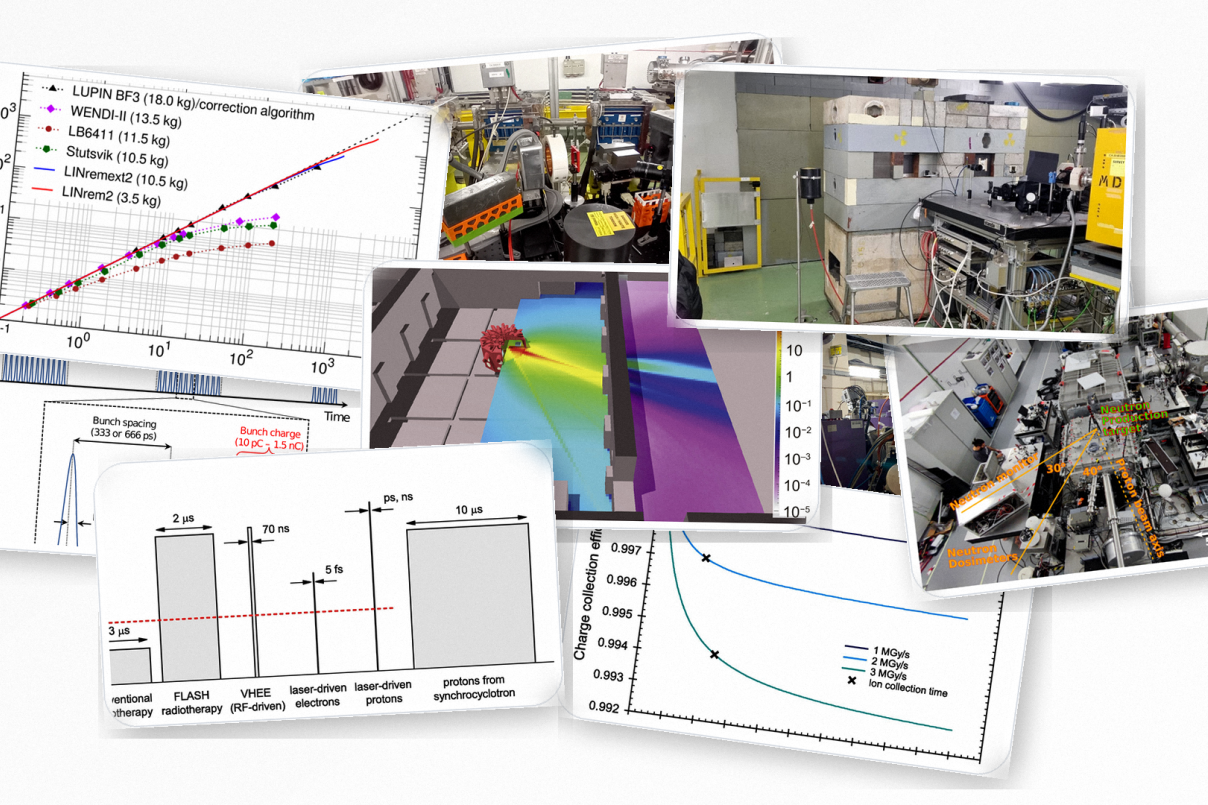
online, 10:00-11:00 CEST
Overview
EURADOS WG11 - Webinars “Pulsed radiation fields: Methods of production and Dose measurements”
Abstract
Recent advances in laser-driven accelerators have boosted the development of high dose-rate, fast-pulsed facilities worldwide. In these environments, stray radiation is dominated by high-energy photons, producing extremely high instantaneous dose rates up to several kGy/s, delivered within pulse durations on the order of femto- to picoseconds. Other facilities generating mixed pulsed radiation fields include particle accelerators with fast-extracted beams, plasma wakefield accelerators, spallation sources, thermonuclear fusion facilities, and accelerators used for FLASH radiation therapy within the medical field.
At such facilities, pulse durations are typically far shorter than the dead time of detector systems (generally a few microseconds for state-of-the-art instrumentation). The combination of very small duty factors and very high instantaneous dose rates imposes severe limitations on radiation protection instrumentation and makes dose measurements particularly challenging. Instruments therefore need to be evaluated for their linearity in response and must ideally be validated under representative conditions. Over recent years, Working Group 11 of EURADOS has promoted a series of intercomparisons aimed at testing instruments and methodologies in pulsed stray radiation fields.
Working Group 11 is organising two webinars on pulsed radiation fields. The first webinar will cover the production mechanisms and characteristic features of pulsed fields and will present example facilities. The second webinar will bring together expert contributions on dose-measurement technologies applicable to pulsed radiation fields.
Topics
Ariel Tarifeno Saldivia
Title Addressing Modern Challenges in Neutron Dosimetry: The LINrem Approach
Abstract Commercial ambient neutron dosimeters face significant challenges in modern radiation facilities. Devices designed in the 1990s-2000s show limited response above 20 MeV, excessive weight (>9 kg posing occupational risks), and inadequate performance in pulsed fields. These gaps are critical in hadron therapy, high-intensity lasers, and advanced research facilities requiring measurements in complex mixed fields with broad energy distributions. This presentation introduces the LINrem project, developing complementary dosimeter designs optimized for different facility requirements: ultra-portable solutions for standard energy ranges and improved-portability designs for extended energy applications (thermal-GeV). We discuss the technical design concepts and present experimental validation in two representative modern facilities: ambient dose measurements in pulsed high-intensity laser sources, and temporally-resolved secondary neutron dose mapping in proton therapy centers.
Biography Ariel Tarifeño-Saldivia is a CSIC permanent researcher at IFIC (Valencia, Spain) working in experimental neutron physics across fundamental and applied topics. He leads the LINrem project on innovative neutron dosimeters for pulsed fields and hadron therapy, serves as spokesperson of HENSA, and is author of 190+ publications and inventor of the patented “Neutron Dosimeter” family.
Faustino Gomez Rodriguez
Title Ionization Chambers in Ultra High Dose per Pulse conditions
Abstract The development of new applications - particularly in FLASH radiotherapy - using pulsed beams with ultra-high dose per pulse (UHDP) has led to a crisis in the use of ionization chambers as the gold standard for dosimetry. Existing Codes of Practice rely on ionization chambers to provide dose traceability for user beams, yet commercial chambers experience significant recombination effects under UHDP conditions.
On one hand, analytical models such as Boag's theory have proven inadequate for accurately describing the behavior of vented ionization chambers exposed to UHDP beams. On the other hand, recent work by Fenwick and Kumar has provided a more realistic description of the problem, complementing other phenomenological approaches (e.g., logistic models). The development of physically based analytical models remains limited due to the nonlinear nature of charge-carrier transport and electric-field perturbations.
Numerical models offer a promising alternative, as they are capable of describing not only charge loss due to recombination but also the instantaneous electrical current produced within the chambers. These models have already guided the design of new parallel-plate ionization chambers with very small electrode spacing or reduced pressure and have yielded predictions regarding the pressure dependence of charge collection efficiency, as well as the interplay between polarity and recombination in thimble ionization chambers.
Biography Faustino Gomez Rodriguez is Professor at the University of Santiago de Compostela (USC) and founder/director of the USC Radiation Physics Laboratory (SSDL), providing dosimetry traceability for Spanish radiotherapy services. His work focuses on radiotherapy and FLASH dosimetry, including contributions to IAEA TRS-483 and the development of solid-state sensors and ultra-thin ionization chambers for ultra-high dose-rate applications.
Benoit Lefebvre
Title Filter Stack Spectrometers for Pulsed Radiation
Abstract Filter Stack Spectrometers are a new class of spectrometric devices well suited for the measurement of pulsed radiation fields. They consist of a sequence of filters interleaved with dose-sensitive layers, from which the characteristics of the ambient radiation field can be determined through an unfolding procedure. Such devices are widely deployed at high-power laser facilities for fundamental physics experiments as well as for radiation monitoring and occupational dosimetry.
Biography Benoit Lefebvre is a detector scientist at the ELI Beamlines Facility of the Extreme Light Infrastructure ERIC (Prague, Czech Republic). He develops instrumentation for radiation detection at laser-driven beamlines, supporting beam diagnostics, radiation protection, and fundamental plasma physics research. He is also an expert in Monte Carlo simulations for radiation transport and contributes actively to the CERN–FLUKA collaboration. He also worked on the development on muon detection system for high-energy physics experiments.
Programme
Presentations:
- Ariel Tarifeno Saldivia: Addressing Modern Challenges in Neutron Dosimetry: The LINrem Approach
- Faustino Gomez Rodriguez: Ionization Chambers in Ultra High Dose per Pulse conditions
- Benoit Lefebvre: Filter Stack Spectrometers for Pulsed Radiation
Registration info
Registration at: https://zoom.us/meeting/register/xaPLryfIRduGdHIbkNaOmA#/registration