
Survey - Continuation of the WG7/13 task internal dosimetry in RPT
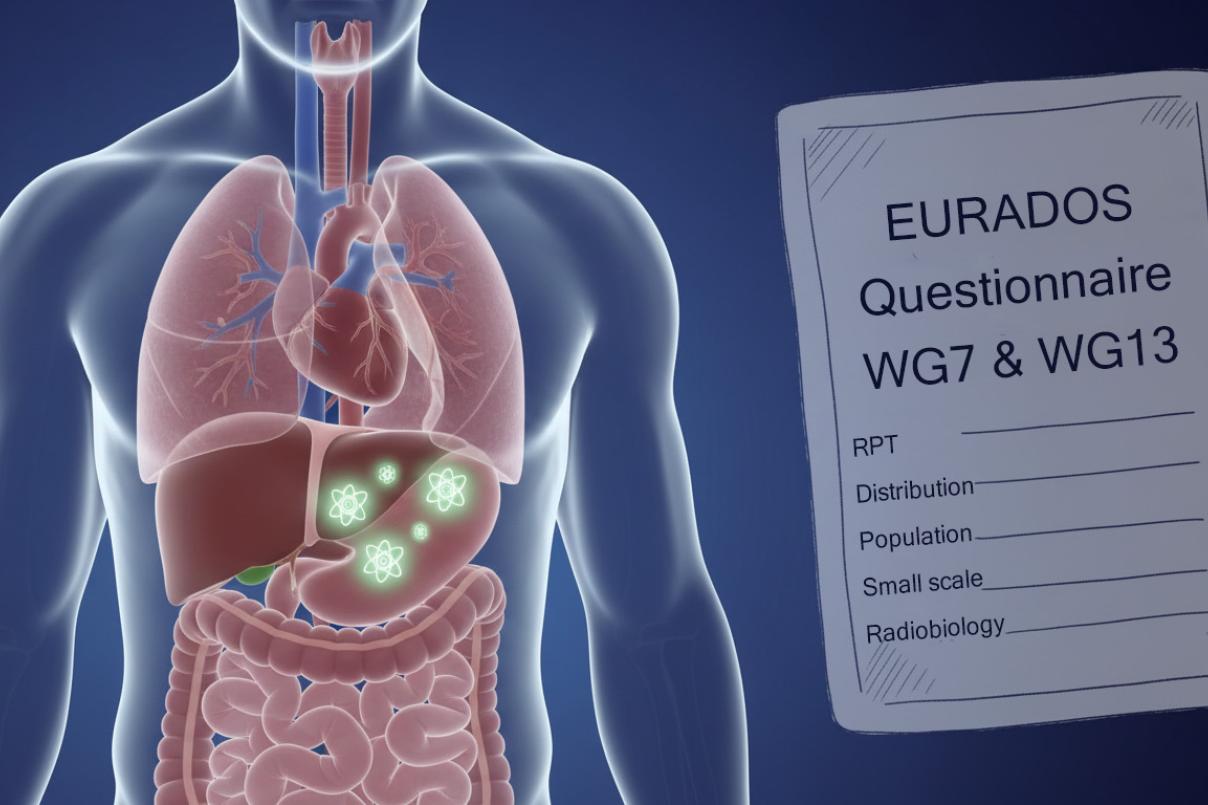
EURADOS task group operating within WG7 (internal dosimetry) and WG13 (dosimetry in nuclear medicine)
For the continuation of our task on advancing personalised dosimetry in radiopharmaceutical therapy, we are looking for your input to help us assess feasibility, identify available interest and resources, and shape the continuation of the work on internal dosimetry in radiopharmaceutical therapy within EURADOS. If you are interested in joining the task and have not yet completed our survey, please do so via this link: Continuation of the task internal dosimetry in RPT
Building on the conclusions of EURADOS Report 2024-03, we recognise that advancing personalised Radiopharmaceutical Therapy (RPT) requires innovative approaches to:
- Predict radiopharmaceutical (RP) distributions at tissue and sub-tissue level;
- Understand energy deposition and radiobiological mechanisms at smaller scale;
- Establish dose-effect relationships in RPT.
For the continuation of our task, we are considering two potential themes, focussed on the first two aspects. Given the challenges in accessing clinical data, and considering the expertise and availability of EURADOS members (i.e. you) we aim to first explore what are feasible goals before deciding on how to proceed.
To this end we have provided a brief introduction to each theme. This is followed by a questionnaire which will help us assess feasibility, identify available interest and resources and shape the continuation of the work on internal dosimetry in radiopharmaceutical therapy within EURADOS.
In summary, would you be interested in either one of these themes?
Theme 1: Incorporating Population Modelling Concepts into RP Distribution Prediction
Theme 2: Predicting RP Distribution at Smaller Scales (in Time and Space)
The questionnaire can be found here: Continuation of the task internal dosimetry in RPT
Theme 1: Incorporating Population Modelling Concepts into RP Distribution Prediction
This theme will focus on leveraging population-based modelling approaches to improve the prediction of RP distribution across patient cohorts. These models can help identify variability and uncertainty in RP uptake and kinetics, thereby supporting more robust treatment planning for both prostate specific membrane antigen (PSMA)- and somatostatin analogues (SSA)- based therapies (for prostate cancer and neuroendocrine tumours (NETs), respectively).
Key questions we aim to address:
- What population modelling frameworks are currently used in pharmacology or internal dosimetry?
- Which different models are used in our field (and EURADOS team) to predict RP distribution?
- Which parameters are most critical for predicting RP distribution?
Expected outcome: Set-up of a (processed) multi-centre dataset using a unified processing format (to agree on). This dataset will allow us to identify: 1) parameters most relevant for predicting RP distribution, 2) relevant sub-populations based on specific patient characteristics who may benefit from non-standard dosing regimes and 3) how population based distribution models may be incorporated in a dosimetry workflow.
Additionally, we aim to perform an inter-comparison of different population-based distribution models using the multi-centre dataset. One of the possible analyses for this intercomparison would be to gather recommendations on the type of constraints to derive administration regimes in TRT.
Theme 2: Predicting RP Distribution at Smaller Scales (in Time and Space) and link with radiobiological mechanisms
This theme will address the need to understand RP behaviour at sub-tissue or cellular levels, considering both the spatial and temporal aspect of energy deposition. It is hypothesised that better understanding these spatial and temporal aspects will help to increase our knowledge on dose-effect relationships in RPT. Given the limited access to clinical data at small spatiotemporal scale, this theme relies on using and combining information from pre-clinical data which may be used in simulation tools and translated towards clinical observations.
Key questions we would like to study:
- How to quantify activity distributions at sub-tissue or cellular level and how to convert this to dose and/or radiation damage.
- How to link small-scale absorbed dose values to relevant biological endpoints and explore which parameters are essential for the development or optimisation of dose response models for RPT.
- How pre-clinical predictive models for pharmacokinetics can be translated towards clinical predictive models.
Expected outcome: Providing knowledge, data, tools, simulation frameworks that will help in explaining dose-response relationships for RPT and contribute towards optimized therapy by means of pre-clinical studies and their translation towards clinical studies.
Given the broad range of disciplines involved in this theme, the various research questions must be further broken down into clearly defined tasks with manageable objectives. The small-scale dosimetry task in WG13 and the micro-and nanodosimetry task in WG6 have already started some initiatives in this direction, collaboration with them would be preferred.
At this point, we would like to have a better idea of the interest and expertise available within EURADOS to contribute in these themes and the availability of data that will be crucial. . The questionnaire below will help us to define the scope, construct task groups and willingness/availability for sharing data. Based on your feedback, we will decide on the continuation of the task, and if found positive, organise a kick-off meeting during the EURADOS AM2026 in Helsinki.
Please fill in our questionnaire via this link: Continuation of the task internal dosimetry in RPT
Feel free to forward this questionnaire to anyone who you might think that will be interested. Thank you in advance for your feedback.
Best regards, Ramona Bouwman
Task leader internal dosimetry of RPT, a combined task of EURADOS WG7 and WG13